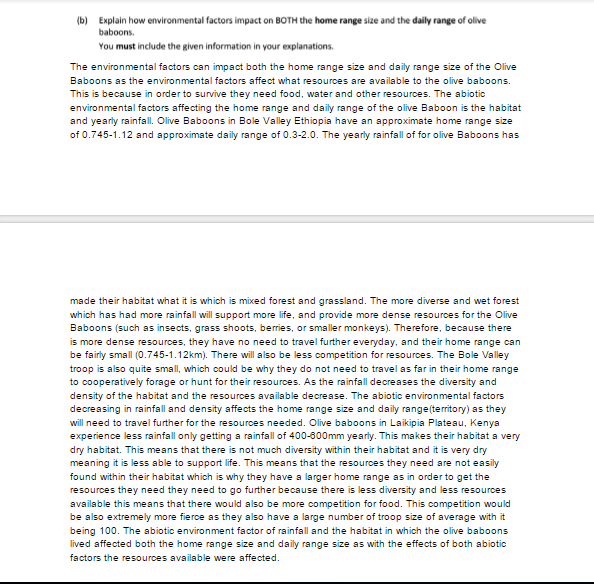
Today in class we were studying for our practice exam that will be happening next week Friday. This is a practice exam question that I tried to answer to get a better understanding on how a question in the exam could ask about territory and home ranges.
Tuesday, 31 May 2016
Practice exam answer: Olive Baboons
Today in class we were studying for our practice exam that will be happening next week Friday. This is a practice exam question that I tried to answer to get a better understanding on how a question in the exam could ask about territory and home ranges.
The life of Tiki the Java Macaque
What is a dominance Hierarchy?
Dominance Hierarchy is determined by how dominant and individual is in a group. Depending on what role the individual person has in the group depends on how dominant the particular individual is in. This shows how the Dominance hierarchy is the organisation of the individual depending on there social rank.
How can a place in the Hierarchy be established?
A place in the Hierarchy can be established by inheritance. When an individual is born into a hierarchy the social ranking of the mother can determine the rank of the child. Tikis mother was in the middle of the social ranking she was still below some of the Java Macaque but was also above others. This meant that when Tiki was born he would be below the Children of women who had a higher social rank then his mother but he would be above children whose mothers had a lower social rank than his mother.
Another way they could establish there place in the Hierarchy is through aggressively fighting. As they become older they are able to fight for there place to become more domiant and show that they are more dominant. In Tiki's case he first served and got into the good books of the other Java Macaque on top of him so that he would be able to challenge the Alpha and become the Alpha himself once he was ready. Tiki was born at the top of the hierarchy but through aggressively fighting to became the alpha.
Who is in a Hierarchy?
In a Hierarchy there is a Alpha,Beta and Submissive's. In tikis particular Hierarchy he was above some but below others. Tiki was first submissive to those above him but worked his way to the top of the hierarchy later becoming the Alpha.
How is a hierarchy Maintained?-Agnostic behavior definition
The Hierarchy can be maintained through Agnostic behaviors.Agnostic behaviors are used by higher ranked animals in the particular social group will use displays to put someone that is lower then them in there place. Agnostic behaviors include threats as well as aggressive behavior. Agnostic behaviors can include biting,showing teeth,pecking, posturing(displaying strength),Dominant/submissive body language or actions,snarling and warning signs.
Benefits of the Hierarchy?
Hierarchies are helpful as it allows social groups to be able to live together.
The benefits of a hierarchy include that fact that it limits fighting as the particular species know there place within there particular social group. The actual amount of severe aggressive fighting is limited because of this. This takes away the risk of them being killed or getting badly hurt because of the aggressive fighting that would happen otherwise.
The social groups maintained through the hierarchy are able to obtain resources through hunting more effectively as they are able to do it together as group.
The amount of competition between the particular social group is reduced as they know when they are allowed access to mates and when they are allowed access to food as they go by who is more dominant.
Non-Breeding individuals in the Hierarchy can help raise the offspring of others.
The social groups maintained through the hierarchy are able to obtain resources through hunting more effectively as they are able to do it together as group.
The amount of competition between the particular social group is reduced as they know when they are allowed access to mates and when they are allowed access to food as they go by who is more dominant.
Non-Breeding individuals in the Hierarchy can help raise the offspring of others.
Thursday, 5 May 2016
Navigation for Migration and Homing
Yesterday in class we learnt about how animals use different types of navigation when Migrating and homing. These different ways included Visual cues when they use their visuals to know where to go, Star compass when animals use the stars to navigate, Magnetic when they use the Earths magnetic field as a way of navigation they can feel the world's magnetic field and can tell where on the earth they are through this, Sun compass is when animals use Sun as a way of navigating. Homing is when animals are able to return home after searching for food or mates from a short distance. Migration is a journey made by animals often over long distances, often once a year or once in a lifetime where they move from once region to another.
Godwits are New Zealand Native birds. Bar-Tailed Godwits Migrate from New Zealand to as far as Alaska. To navigate during their migration from New Zealand to Alaska and back they use all the different types of navigation to get there but also need to be very skill full in knowing the different types of weather they may experience during their journey. Although there are disadvantages while taking this journey the advantages outweigh the disadvantages which is why they migrate. The advantages include their need to find different types of food in different seasons and the amount of food they need in those seasons. The Godwits migrate because of their need to find resources of different seasons this includes Mudflats and seafloor dwelling fauna. The advantages include a larger source of food for birds that will be breeding and for their young. The disadvantages of this long journey is the energy it cost to do this, the chances of being eaten and the fact when they arrive wings are drooping.
The poster below shows how we know these different types of navigations are actually used by animals
Godwits are New Zealand Native birds. Bar-Tailed Godwits Migrate from New Zealand to as far as Alaska. To navigate during their migration from New Zealand to Alaska and back they use all the different types of navigation to get there but also need to be very skill full in knowing the different types of weather they may experience during their journey. Although there are disadvantages while taking this journey the advantages outweigh the disadvantages which is why they migrate. The advantages include their need to find different types of food in different seasons and the amount of food they need in those seasons. The Godwits migrate because of their need to find resources of different seasons this includes Mudflats and seafloor dwelling fauna. The advantages include a larger source of food for birds that will be breeding and for their young. The disadvantages of this long journey is the energy it cost to do this, the chances of being eaten and the fact when they arrive wings are drooping.
The poster below shows how we know these different types of navigations are actually used by animals
Sunday, 17 April 2016
An experience at Teaching
For our lesson with only four students on the 5th of April 2016 we each got to experience what it was like to be a teacher. All of us had to come up with an activity to teach the other students about a particular topic given to us by our teacher.
Tropism and growth responses
First we were taught about tropism and growth responses by Cherub. She taught this to us through doing a word search. The word search did not show us the words but the meanings and we had to try figure out the words for ourselves. The words and definitions linked to the topic of tropism and growth, Overall what I learn't about this topic is that tropism is the directional growth of Plants that may be negative or positive and is in response to an external environment.
Investigating Gravitropism
Lana taught us about investigating gravity. She taught us through a presentation which explained what we had to do. We had to draw how the hormone of Auxin is involved in gravitropism in plants. Overall I learnt that in the stem Negative gravitropsim is happen this is because the bottom of the cell is elongating allow the plant to bend and go against gravity. In the root Auxin is also in the bottom layer but it is telling the cells to not elongate as the top cell elongates. This means that positive gravitropsim is happening in the roots.
Nastic responses
Rita taught us about Nastic responses. She taught this to us through a presentation and Kahoot. The Kahoot was won by Cherub. Overall I learnt that Nastic responses they are growth of plants in the direction of the plant response and does not rely on the direction of the stimulus.
Investigating Phototropism
I taught the class about Phototropism and how there was investigation conduct of phototropism, I taught this by first making questions through a presentation and then making these questions in the presentation into a kahoot for the class to play. I wanted to teach through a kahoot as it is a fun way of learning and because it would be fun I believed that other students in my class would be more interested in learning about the topic. What I wanted the class t learn overall was about how Auxin affects Phototropism.
Answers to questions in presentation
1.Makes cells grow by elongating them
2.It goes to where there is no light
3. The Auxin become inactivated by the light
4. By differential growth
5.yes
Tropism and growth responses
First we were taught about tropism and growth responses by Cherub. She taught this to us through doing a word search. The word search did not show us the words but the meanings and we had to try figure out the words for ourselves. The words and definitions linked to the topic of tropism and growth, Overall what I learn't about this topic is that tropism is the directional growth of Plants that may be negative or positive and is in response to an external environment.
Investigating Gravitropism
Lana taught us about investigating gravity. She taught us through a presentation which explained what we had to do. We had to draw how the hormone of Auxin is involved in gravitropism in plants. Overall I learnt that in the stem Negative gravitropsim is happen this is because the bottom of the cell is elongating allow the plant to bend and go against gravity. In the root Auxin is also in the bottom layer but it is telling the cells to not elongate as the top cell elongates. This means that positive gravitropsim is happening in the roots.
Nastic responses
Rita taught us about Nastic responses. She taught this to us through a presentation and Kahoot. The Kahoot was won by Cherub. Overall I learnt that Nastic responses they are growth of plants in the direction of the plant response and does not rely on the direction of the stimulus.
Investigating Phototropism
I taught the class about Phototropism and how there was investigation conduct of phototropism, I taught this by first making questions through a presentation and then making these questions in the presentation into a kahoot for the class to play. I wanted to teach through a kahoot as it is a fun way of learning and because it would be fun I believed that other students in my class would be more interested in learning about the topic. What I wanted the class t learn overall was about how Auxin affects Phototropism.
Answers to questions in presentation
1.Makes cells grow by elongating them
2.It goes to where there is no light
3. The Auxin become inactivated by the light
4. By differential growth
5.yes
Tuesday, 5 April 2016
Playdoh Phototropism
In this lesson we made an animation out of Playdoh to represent how Auxin is produced in the shoot of the stem and what happen afterwards. The animation also shows phototropism in plants. This is when plants move in the direction of light. The Hormone Auxin makes this possible as instead of going to where the light is Auxin goes to the shady side of the Plant. The hormone of Auxin works by Elongating cells. This allows the plant to go towards the sun as it bend due to one side being longer. If Auxin happens to grow on to the light side of the plant the Auxin inside will become inactive. This is what our animation shows.
In this lesson we were fortunate enough to not only learn about Auxin for ourselves but through demonstrating how it works our visitor was able to learn something new.
Monday, 14 March 2016
My Critter:Taxis
In class we had to create our own critters.My Critter is called the Octarabbit. The Octarabbit lives under the water and when it is trying to find its way home it sensors the chemical of Randomness in order to find its way back home. What is orientation response and adaptive advantages for the Octrabbit?
Wednesday, 9 March 2016
My First Assesment:Homeostasis
Our first Assessment for this year is about how we maintain stable internal environments Homeostasis. For me at the start of this assessment I was worried as I felt like I would not do well and did not fully understand the topic. This began to change as I started writing and finding out more information about the topic as everything started to click in to place and become understandable. Compared to year 12 I found that this assessment was a lot easier than last year. Especially if I was to compare this assessment to our gas exchange assessment last year. To be successful for this assessment I reckon you just have to be good at trying to find the best and most relevant information and to be calm and just try your best. Things will become more understandable.
Subscribe to:
Posts (Atom)
